M-Sand vs River Sand: Which Is Better for Concrete and Plaster?
With river sand scarce and regulated in many states, M-sand has become mainstream. Here is how it compares and how to use it well.
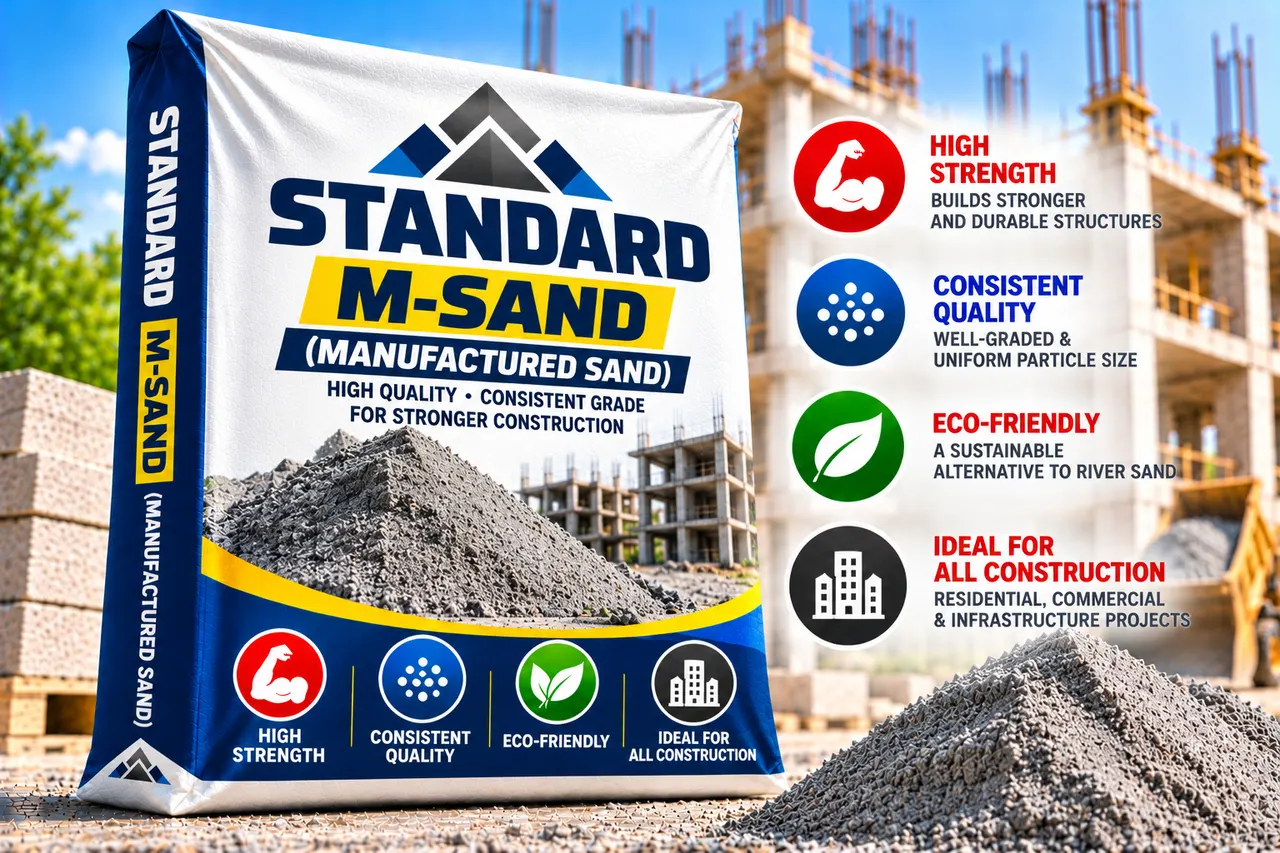
M-sand (manufactured sand) is produced by crushing hard rock and grading it to sand sizes; it is recognised for concrete under IS 383:2016. Good M-sand has consistent grading, no organic impurities and little clay, and can give equal or higher concrete strength than river sand. Its angular particles may need slightly more water or a plasticiser for workability. Use concrete-grade M-sand (0–4.75 mm) for concrete and finer plaster sand (P-sand) for plastering. River sand is naturally rounded and workable but increasingly scarce, variable and often silty.
What is M-sand?
Manufactured sand (M-sand) is made by crushing hard granite or basalt in crushers, shaping the particles (often in vertical shaft impactors) and washing or air-classifying to remove excess fines. IS 383:2016 recognises manufactured sand as fine aggregate for concrete.
Side-by-side comparison
| Property | M-sand | River sand |
|---|---|---|
| Source | Crushed rock | River beds |
| Availability | Steady, from quarries | Scarce, seasonal, regulated |
| Particle shape | Angular, cubical when well made | Rounded |
| Grading | Controlled, consistent | Varies by source and season |
| Silt and clay | Low when washed | Often present |
| Organic impurities | None | Possible |
| Workability | Slightly lower; may need plasticiser | Good |
| Concrete strength | Equal or higher | Good |
| Environmental impact | Quarry-based; avoids river mining | River mining damages ecosystems |
M-sand vs P-sand
- M-sand (concrete grade): typically 0–4.75 mm, graded for concrete (usually Zone II grading).
- P-sand (plaster sand): finer, typically up to about 2.36 mm, for plastering and masonry where a smooth finish is needed.
Using coarse concrete-grade M-sand for fine plaster gives a rough finish; use P-sand.
Using M-sand well
- Buy washed, graded M-sand from established crushers; ask for grading and fines test results.
- Check fines — material finer than 75 microns must be within IS 383 limits.
- Adjust the mix — angular particles may need a plasticiser rather than extra water. See water-cement ratio.
- Use design mixes for M25 and above with your actual M-sand.
- Cure properly, as with any concrete.
Watch out for
- "M-sand" that is really unwashed crusher dust with high fines
- Flaky, elongated particles from poor crushing
- Mixing different sand sources mid-pour
River sand: what to check
- Silt content — use the silt test.
- Organic matter — dark colour, roots and shells are warning signs.
- Salt — for coastal sources, ensure sand is washed.
Key takeaways
- Good M-sand is a reliable, IS 383-recognised alternative to river sand.
- Use concrete-grade M-sand for concrete and P-sand for plaster.
- Buy washed, graded material and adjust mixes with plasticisers.
Browse sand available for your pincode.
Frequently asked questions
Is M-sand good for house construction?
Yes. Washed, well-graded M-sand meeting IS 383 is widely used for concrete and, in its finer P-sand form, for plaster.
What is the difference between M-sand and P-sand?
M-sand for concrete is typically 0–4.75 mm; P-sand is finer (up to about 2.36 mm) and used for plastering and masonry for a smoother finish.
Does M-sand need more cement?
Not necessarily. Its angular shape may need slightly more water or a plasticiser for workability; using a plasticiser keeps the water-cement ratio and cement content in check.
Need materials for this work?
See indicative delivered prices for your pincode, or get an itemised project quotation with freight, unloading and GST shown line by line.
This guide is general information for planning and buying. Quantities, grades and methods for your structure must follow your approved drawings, your engineer’s specification and the applicable Indian Standards.