TMT Bar Grades Explained: Fe 500 vs Fe 500D vs Fe 550D
The number is the yield strength; the "D" is about ductility. Here is what each TMT grade means and which one your building needs.
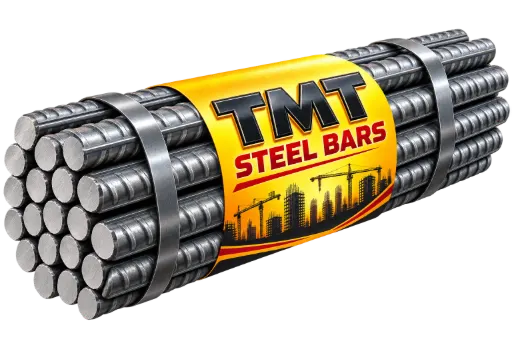
In TMT bar grades, the number is the minimum yield strength in N/mm²: Fe 500 bars yield at 500 MPa or more, Fe 550 at 550 MPa or more. The "D" suffix (Fe 500D, Fe 550D) means higher ductility under IS 1786 — more elongation (16% for Fe 500D vs 12% for Fe 500), a higher ratio of tensile to yield strength and lower carbon, sulphur and phosphorus. D grades are preferred in earthquake-prone zones. Use the grade specified in your structural drawing.
What does "Fe 500" mean?
Fe is the chemical symbol for iron. The number is the minimum yield strength (more precisely, 0.2% proof stress) in N/mm² (MPa). Fe 500 bars must not start to yield permanently below 500 MPa.
TMT stands for Thermo-Mechanically Treated — a process of quenching hot-rolled bars with water and letting the core temper the surface. It produces a hard outer layer and a softer, ductile core.
What does the "D" mean?
"D" grades have enhanced ductility: they can stretch and bend more before breaking. That matters in earthquakes, where structures must absorb energy through controlled deformation rather than sudden failure.
IS 1786 requirements (key values)
| Grade | Min. yield (MPa) | Min. UTS/YS ratio | Min. UTS (MPa) | Min. elongation |
|---|---|---|---|---|
| Fe 415 | 415 | 1.10 | 485 | 14.5% |
| Fe 500 | 500 | 1.08 | 545 | 12.0% |
| Fe 500D | 500 | 1.10 | 565 | 16.0% |
| Fe 550 | 550 | 1.06 | 585 | 10.0% |
| Fe 550D | 550 | 1.08 | 600 | 14.5% |
| Fe 600 | 600 | 1.06 | 660 | 10.0% |
D grades also have tighter limits on carbon, sulphur and phosphorus (for example, combined S+P of 0.075% max for Fe 500D vs 0.105% for Fe 500), which improves ductility and weldability.
Which grade should you use?
- Individual houses and low-rise buildings: Fe 500D is the most common choice, especially in seismic zones III, IV and V.
- High-rise and heavily loaded structures: Fe 550D may be specified to reduce steel quantity and congestion.
- Fe 415 is now less common but still used where specified.
Always use the grade in your structural drawing. Switching to a higher grade without the designer's approval can change laps, bends and ductility behaviour.
Higher grade = less steel?
A higher-strength bar can carry more load per kg, so designers may use less steel or smaller diameters. That decision belongs to the structural engineer, not the site.
Quality checks
Look for the BIS mark, grade, size and manufacturer on the bar, and ask for the mill test certificate. See how to check TMT bar quality. For quantities, see steel per sq ft and weight formula.
Browse TMT bars from leading manufacturers.
Key takeaways
- The number is minimum yield strength in MPa.
- "D" means higher ductility and cleaner chemistry — better for earthquakes.
- Fe 500D is the common choice for houses; follow the drawing.
Frequently asked questions
What is the difference between Fe 500 and Fe 500D?
Both have a minimum yield strength of 500 MPa. Fe 500D has higher ductility — minimum 16% elongation versus 12% — a higher tensile-to-yield ratio and lower carbon, sulphur and phosphorus limits under IS 1786.
Which TMT bar grade is best for a house?
Fe 500D is the most common choice for residential buildings, especially in earthquake-prone zones. Always follow the grade specified by your structural engineer.
What does TMT stand for?
Thermo-Mechanically Treated — a quenching and self-tempering process that gives bars a hard outer layer and a ductile core.
Is Fe 550D better than Fe 500D?
Fe 550D has higher strength, which can reduce steel quantity in heavily loaded structures. Fe 500D has higher elongation. The choice depends on the structural design.
Need materials for this work?
See indicative delivered prices for your pincode, or get an itemised project quotation with freight, unloading and GST shown line by line.
This guide is general information for planning and buying. Quantities, grades and methods for your structure must follow your approved drawings, your engineer’s specification and the applicable Indian Standards.