AAC Blocks vs Red Bricks: Cost, Strength, Weight and Insulation Compared
AAC blocks are about a third of the weight of clay bricks and much better insulators. But bricks still have their place. Here is a fair comparison.
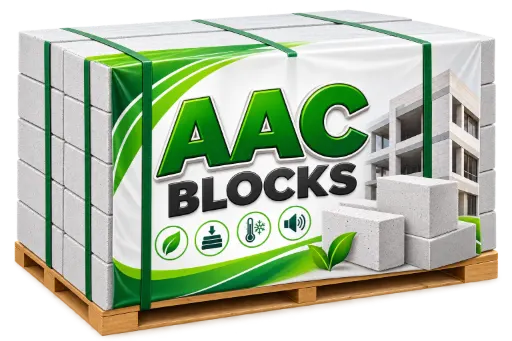
AAC (autoclaved aerated concrete) blocks weigh roughly 550–650 kg/m³ against about 1,600–1,900 kg/m³ for red clay bricks, insulate several times better against heat, are laid faster with thin-bed adhesive and need less mortar and plaster. Red bricks are more widely available, tolerate rough handling and are familiar to all masons. AAC usually lowers structural load and total wall cost on framed buildings, while bricks suit small load-bearing work and areas without AAC supply.
What are AAC blocks?
Autoclaved Aerated Concrete (AAC) blocks are made from cement, lime, fly ash or sand, gypsum and a small amount of aluminium powder, which creates millions of tiny air pockets. The blocks are cured under steam pressure in an autoclave. In India, AAC blocks are covered by IS 2185 (Part 3).
Side-by-side comparison
| Property | AAC blocks | Red clay bricks |
|---|---|---|
| Dry density | ~550–650 kg/m³ | ~1,600–1,900 kg/m³ |
| Typical size | 600 × 200 × 75–300 mm | ~230 × 110 × 75 mm |
| Units per m³ (200 mm thick) | ~42 | ~410 |
| Compressive strength | ~3–4.5 N/mm² (by grade) | ~3.5 N/mm² and up (by class) |
| Thermal insulation | Excellent | Moderate |
| Jointing | Thin-bed adhesive (2–3 mm) or mortar | 10 mm cement mortar |
| Plaster | Thinner, more even | Thicker on uneven bricks |
| Laying speed | Fast | Slower |
| Fire resistance | Very good | Very good |
| Breakage in handling | Needs care | More tolerant |
| Environmental | Uses fly ash, no topsoil | Uses topsoil, kiln-fired |
Advantages of AAC
- Lighter structure — less dead load can reduce steel and concrete in the frame (as designed by the engineer).
- Cooler buildings — better insulation reduces cooling costs.
- Faster construction — one block replaces many bricks.
- Less mortar and plaster — fewer joints, more even surfaces.
- Accurate dimensions — straighter walls.
Advantages of red bricks
- Available almost everywhere, in any quantity.
- Familiar to every mason; no special adhesive or tools.
- Robust to rough handling and transport.
- Good for small load-bearing structures and boundary walls.
Cost: compare per square metre of finished wall
Comparing price per block vs per brick is misleading. Compare the finished wall cost per m²: units + mortar or adhesive + labour + plaster + any structural savings. AAC often comes out competitive or cheaper on framed buildings, especially multi-storey.
When AAC may not suit
- Very small jobs where AAC supply is uneconomical
- Load-bearing walls without proper design
- Areas exposed to constant moisture without protection
See AAC block wall construction guide for how to build them right, and fly ash vs clay bricks for another alternative.
Browse AAC blocks or bricks for your site.
Key takeaways
- AAC is about one-third the weight of clay brick and insulates far better.
- AAC builds faster with less mortar and plaster.
- Compare finished wall cost, not unit price.
Frequently asked questions
Are AAC blocks better than red bricks?
For framed buildings, AAC blocks are usually better for weight, insulation, speed and finish. Red bricks remain practical for small load-bearing work and where AAC is not readily available.
How many AAC blocks are in 1 cubic metre?
About 42 blocks of 600 × 200 × 200 mm, before allowing for joints and wastage.
Is AAC block construction cheaper?
Per unit, AAC may look costlier, but per square metre of finished wall — including mortar, plaster, labour and structural savings — it is often competitive or cheaper.
Which standard covers AAC blocks in India?
IS 2185 (Part 3) covers autoclaved cellular (aerated) concrete blocks.
Need materials for this work?
See indicative delivered prices for your pincode, or get an itemised project quotation with freight, unloading and GST shown line by line.
This guide is general information for planning and buying. Quantities, grades and methods for your structure must follow your approved drawings, your engineer’s specification and the applicable Indian Standards.