AAC Block Wall Construction: Step-by-Step Guide and Common Mistakes
AAC blocks are easy to lay — and easy to lay wrongly. Follow these steps to get straight, crack-free walls.

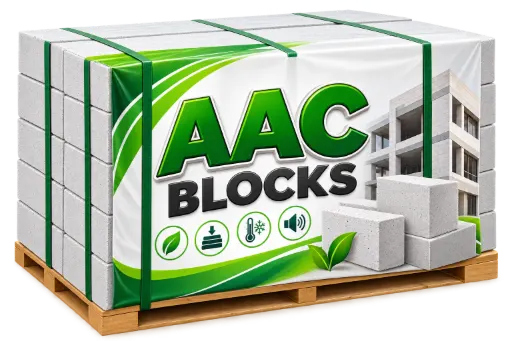
To build an AAC wall: lay the first course in cement mortar on a clean, levelled base, check line and level; lay subsequent courses with thin-bed AAC adhesive (about 2–3 mm) applied with a notched trowel, staggering vertical joints by at least a quarter block; tie the wall to columns with mesh or ties; provide lintels over openings and a horizontal band if specified; cut and chase only with proper tools; and fix mesh at junctions before plastering. Do not soak AAC blocks in water.
Tools and materials
- AAC blocks of the specified size and grade
- AAC block adhesive (thin-bed jointing mortar), or cement mortar as specified
- Notched trowel, rubber mallet, spirit level, string line
- AAC hand saw or cutting machine, rasp or planer
- Galvanised wall ties or mesh strips; chicken mesh for plaster junctions
Step-by-step
1. Prepare the base. The slab or beam surface must be clean, level and free of dust. Mark the wall line.
2. First course in mortar. Lay the first course in cement mortar (about 1:4 to 1:6) to correct any unevenness in the base. Check line and level carefully — every course above depends on it. Many builders use a damp-proof layer below the first course in wet areas.
3. Adhesive for upper courses. Mix adhesive as per the manufacturer. Apply evenly with a notched trowel on the bed and vertical faces. Joint thickness is typically 2–3 mm.
4. Place and tap. Place each block and tap with a rubber mallet to bed it. Check level and plumb frequently.
5. Stagger joints. Offset vertical joints by at least a quarter block (150 mm) from the course below. No continuous vertical joints.
6. Cutting. Cut blocks with an AAC saw for clean edges. Rasp uneven surfaces flat.
7. Tie to columns. Fix galvanised ties or mesh into column faces and embed in every second or third course, as specified.
8. Lintels and bands. Provide RCC or precast lintels over doors and windows with adequate bearing. Long or tall walls may need a horizontal RCC band as designed.
9. Top gap. Leave a small gap of about 10–20 mm under beams or slabs and fill it later with a compressible or flexible filler, so slab deflection does not crack the wall.
10. Chasing for services. Use a chasing tool, not a hammer and chisel. Fill chases with suitable mortar.
11. Plaster. Fix chicken mesh across column/beam junctions. AAC walls need thinner plaster (often 10–12 mm internal), applied as recommended for AAC. Gypsum plaster is common internally.
12. Curing. Cure the first-course mortar and plaster. AAC adhesive is often self-curing; follow the manufacturer.
Common mistakes
| Mistake | Result |
|---|---|
| Soaking blocks in water | Shrinkage cracks, weak bond |
| Using thick cement mortar in all courses | Wasted mortar, more shrinkage |
| No ties to columns | Cracks at wall-column junctions |
| No gap under beams | Cracks when slab deflects |
| Hammering chases | Broken blocks, cracks |
| Unstaggered joints | Weak walls |
How many blocks and how much adhesive?
About 42 blocks per m³ for 600 × 200 × 200 mm blocks. Adhesive consumption depends on block size and joint thickness — check the manufacturer's coverage per bag.
Compare with bricks in AAC blocks vs red bricks. Browse AAC blocks.
Key takeaways
- First course in mortar, upper courses in thin-bed adhesive.
- Do not soak blocks; stagger joints; tie to columns.
- Leave a flexible gap under beams; mesh at junctions before plaster.
Frequently asked questions
Should AAC blocks be soaked in water before laying?
No. Unlike clay bricks, AAC blocks should not be soaked. At most, lightly dampen the surface in very hot weather if the adhesive manufacturer recommends it.
What is the joint thickness for AAC blocks?
With thin-bed adhesive, joints are typically 2–3 mm. The first course is laid in cement mortar to level the base.
Why do AAC walls crack?
Common causes are soaking blocks, thick cement mortar joints, lack of ties to columns, no gap under beams, poor chasing and missing mesh at junctions.
Need materials for this work?
See indicative delivered prices for your pincode, or get an itemised project quotation with freight, unloading and GST shown line by line.
This guide is general information for planning and buying. Quantities, grades and methods for your structure must follow your approved drawings, your engineer’s specification and the applicable Indian Standards.