What Is PPC Cement? Uses, Benefits and Limitations
Portland Pozzolana Cement is the most widely used cement in Indian housing. Learn what goes into it, why it is durable and where it is not the right pick.
PPC (Portland Pozzolana Cement) is OPC clinker blended with 15–35% fly ash and gypsum, made to IS 1489 (Part 1). It gains strength more slowly than OPC but keeps getting stronger, produces less heat, resists sulphates and chlorides better and gives denser, less permeable concrete. It is ideal for foundations, slabs, plaster, masonry and mass concrete, but less suitable where very high early strength is needed.
What does PPC stand for?
PPC stands for Portland Pozzolana Cement. It is made by intergrinding or blending OPC clinker and gypsum with a pozzolana, which in India is almost always fly ash from thermal power plants. Under IS 1489 (Part 1):2015, the fly ash content in PPC is between 15% and 35% by mass.
A pozzolana does not set on its own. It reacts with the calcium hydroxide released when cement hydrates and forms extra binding gel. That secondary reaction is the reason PPC concrete becomes denser and more durable over time.
How strong is PPC compared to OPC?
PPC must reach at least 33 MPa at 28 days under IS 1489, but commercial PPC brands routinely exceed that. The bigger difference is the shape of the strength curve:
| Age | OPC 43 | PPC |
|---|---|---|
| 3 days | Faster | Slower |
| 7 days | Faster | Slower |
| 28 days | Similar range | Similar range |
| 90 days and beyond | Levels off | Continues to gain |
In practice, a well-made PPC concrete often matches OPC at 28 days and overtakes it later. What PPC needs in return is longer, more patient curing — at least 10 days of moist curing is the usual guidance for blended cements.
What are the main benefits of PPC?
- Lower heat of hydration — fewer thermal cracks in rafts, footings and thick slabs.
- Lower permeability — the extra gel fills pores, so water and salts move through concrete more slowly.
- Better resistance to sulphates and chlorides than plain OPC, which helps in foundations, basements and moderately aggressive soils.
- Better workability and finish — fine, spherical fly ash particles help mortar flow and give a smoother plaster.
- Lower carbon footprint — using fly ash reduces the clinker in every bag. See low-carbon blended cement.
- Usually priced lower than OPC from the same brand.
Where is PPC the right choice?
- Foundations, footings, rafts and plinth beams
- Roof slabs and beams in residential buildings (as specified by your engineer)
- Brickwork and blockwork mortar
- Internal and external plaster
- Water tanks, sumps and drains
- Mass concrete such as retaining walls and dams
When should you avoid PPC?
- Precast yards and fast formwork cycles that need high strength in 1–3 days.
- Cold weather concreting, where slow early strength can delay stripping.
- Projects where the design specifies OPC or a particular cement type — always follow the drawing.
- Sites that cannot cure for 10+ days. If curing will be cut short, PPC loses much of its advantage.
Is PPC good for house construction?
For most individual houses, yes. PPC is widely used for the entire building — foundations, frame, masonry and plaster — provided curing is done properly. If you are choosing between grades, read OPC vs PPC for house construction.
How to identify genuine PPC
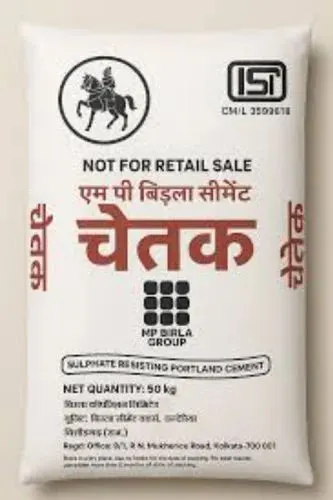
The bag should show "PPC" and IS 1489 (Part 1), the BIS Standard Mark with a CM/L licence number, the manufacturer's address, net weight and the week and year of manufacture. Learn more in how to read a cement bag.
Key takeaways
- PPC = OPC clinker + 15–35% fly ash + gypsum, made to IS 1489 (Part 1).
- Slower early strength, higher long-term strength and better durability.
- Ideal for foundations, slabs, masonry and plaster; less suited to precast and cold weather.
- Cure blended-cement concrete for at least 10 days.
Compare PPC prices delivered to your site across brands.
Frequently asked questions
What is the full form of PPC cement?
PPC stands for Portland Pozzolana Cement. It is OPC clinker blended with a pozzolana — usually fly ash — and gypsum.
How much fly ash is in PPC?
Under IS 1489 (Part 1):2015, PPC contains between 15% and 35% fly ash by mass.
Is PPC weaker than OPC?
PPC gains strength more slowly in the first week, but it continues to gain strength for months and often matches or exceeds OPC concrete at 28 days and beyond.
How many days should PPC concrete be cured?
At least 10 days of continuous moist curing is the usual guidance for blended cements such as PPC, and longer in hot, dry weather.
Can PPC be used for roof slabs?
Yes, PPC is widely used for residential slabs when specified by the engineer and cured properly. Props must stay in place for the full period the engineer specifies.
Need materials for this work?
See indicative delivered prices for your pincode, or get an itemised project quotation with freight, unloading and GST shown line by line.
This guide is general information for planning and buying. Quantities, grades and methods for your structure must follow your approved drawings, your engineer’s specification and the applicable Indian Standards.