OPC vs PPC Cement for House Construction: A Stage-by-Stage Guide
Most homes do not need a single cement for everything. Here is which cement works best at each stage of building a house, and why.
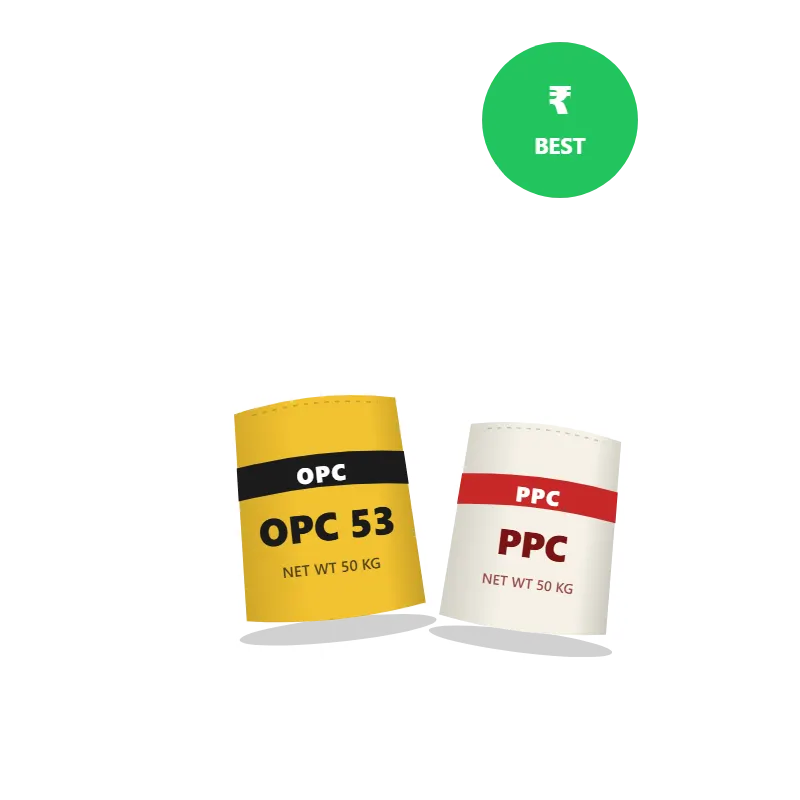
For most houses, PPC is the best all-round cement for foundations, brickwork, plaster and slabs because it is durable, produces less heat and costs less. OPC 53 or OPC 43 is preferred where early strength matters — RCC columns and beams in multi-storey frames, precast elements or tight formwork schedules. Always follow the cement type in your structural drawing.
The short answer
There is no single "best cement" for a house. The right choice depends on the element, the weather and how well your site can cure concrete. A practical approach many engineers use is: PPC for most of the building, OPC where speed or early strength is genuinely required.
Stage-by-stage recommendation
| Stage | Recommended | Why |
|---|---|---|
| Foundation, footings, raft | PPC or PSC | Low heat, better sulphate resistance, durable in soil |
| Plinth beam and DPC | PPC | Durability and low permeability |
| Columns and beams | OPC 53/43 or PPC | OPC for faster cycles; PPC fine with proper curing |
| Roof slab | PPC or OPC 43 | Lower heat reduces shrinkage cracks |
| Brickwork / blockwork | PPC | Workable mortar, good bond |
| Plaster | PPC | Smooth finish, fewer cracks |
| Flooring and tile bed | OPC 43 or PPC | Either works |
| Water tank and sump | PPC or PSC | Low permeability |
Why PPC is the default for most homes
- It is usually cheaper per bag than OPC from the same brand.
- Lower heat means fewer cracks in slabs and plaster.
- Denser concrete in the long run protects steel from moisture.
- Smoother plaster thanks to fine fly ash particles.
The catch: PPC needs at least 10 days of curing. If your site cannot water slabs and walls that long, its advantages shrink.
When to use OPC in a house
- Multi-storey frames where you want to cast one floor every couple of weeks.
- Monsoon or cold weather when early strength helps formwork removal (as approved by the engineer).
- Precast lintels, chajjas or paver blocks made on site.
- Higher-grade concrete (M30+) specified by the structural designer.
Choosing between grades of OPC? Read OPC 53 vs OPC 43.
Can you mix OPC and PPC on the same project?
Yes, on different elements. Do not mix OPC and PPC in the same batch of concrete or mortar, and keep the stacks clearly separated and labelled. Using different brands for the same element is also best avoided, because colour and setting behaviour can differ.
How much cement will a house need?
A common thumb rule is 0.4 to 0.5 bags of cement per sq ft of built-up area for a standard RCC-framed house, covering concrete, masonry and plaster. Our guide on cement required for a 1000 sq ft house breaks this down by stage, or use the cement cost calculator.
Common mistakes to avoid
- Using OPC 53 for plaster to "make it stronger".
- Stopping curing after 3–4 days because the surface looks dry and hard.
- Storing bags on bare floors where they absorb moisture — see cement storage.
- Buying all cement at once for a long project and letting it age.
Key takeaways
- PPC works for most of a house: foundation, masonry, plaster and slabs.
- OPC is useful where early strength or fast cycles matter.
- Follow your structural drawing; never mix types in one batch.
Planning the whole house? Request a quote with both cement types phased to each stage.
Frequently asked questions
Which cement is best for a house roof slab?
PPC or OPC 43 are common choices for residential slabs because they release heat more gently, which reduces shrinkage cracks. Follow the cement type in your structural drawing and cure the slab for the full recommended period.
Which cement is best for plastering walls?
PPC is widely preferred for plaster because it gives a smooth, workable mix with fewer shrinkage cracks.
Is PPC good for foundations?
Yes. PPC (and PSC) are well suited to foundations because of their lower heat of hydration and better resistance to sulphates in soil and groundwater.
Can I use OPC and PPC together?
You can use them for different elements of the same building, but do not mix the two types within a single batch of concrete or mortar.
Need materials for this work?
See indicative delivered prices for your pincode, or get an itemised project quotation with freight, unloading and GST shown line by line.
This guide is general information for planning and buying. Quantities, grades and methods for your structure must follow your approved drawings, your engineer’s specification and the applicable Indian Standards.