10 mm vs 20 mm Aggregate: Which Size for Which Concrete Work?
Aggregate size affects strength, workability and finish. Here is how to pick between 10 mm, 20 mm and 40 mm — and why most RCC uses a blend.
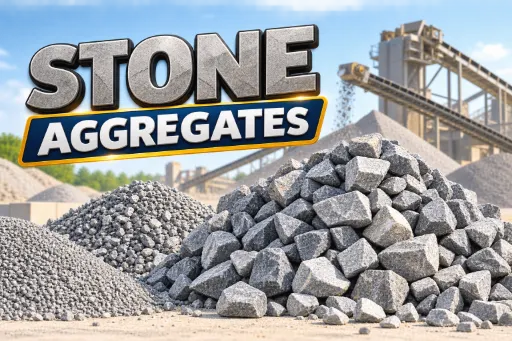
20 mm aggregate is the standard size for most RCC — footings, columns, beams and slabs — because it gives good strength with economical cement content. 10 mm aggregate is used for thin sections, heavily reinforced members, precast products, screeds and as a blend with 20 mm (often around 60:40 or 70:30) to fill voids. 40 mm is used in PCC and mass concrete. Under IS 456, maximum aggregate size should not exceed one-quarter of the minimum member thickness and must pass between bars and into cover.
Common sizes and uses
| Size | Typical uses |
|---|---|
| 6 mm (grit) | Precast blocks, thin toppings, paver blocks |
| 10 mm | Thin slabs and sections, congested reinforcement, screeds, precast, blending with 20 mm |
| 20 mm | Standard RCC: footings, columns, beams, slabs |
| 40 mm | PCC under footings, mass concrete, rafts (where specified), road bases |
IS 456 rules for maximum size
The nominal maximum size of coarse aggregate should be as large as possible within these limits:
- Not more than one-quarter of the minimum thickness of the member.
- For heavily reinforced members, 5 mm less than the minimum clear distance between bars or the minimum cover, whichever is smaller.
Larger aggregate needs less cement paste for the same workability, but it must pass through the steel and fill the formwork completely.
Why blend 20 mm and 10 mm?
A single size leaves large voids. Blending 20 mm with 10 mm fills them, giving denser, more workable concrete with less cement paste. Common site blends are around 60:40 or 70:30 (20 mm:10 mm); a design mix sets the exact ratio from sieve analysis.
Quality checks for aggregate
- Clean — no dust, clay lumps or organic matter. Wash if dusty.
- Hard and strong — from sound rock; no soft or weathered stones.
- Shape — cubical is best; avoid excessive flaky and elongated pieces (IS 383 limits apply).
- Graded — a range of sizes within the nominal size.
- Consistent — same source through a pour.
Storing aggregate
- Separate stockpiles for each size on a hard, clean base.
- Avoid contamination with soil or sand.
- Shade stockpiles in summer — see hot weather concreting.
Quantities
For aggregate quantities per m³ of concrete, see cement bags per cubic metre. M20 nominal mix uses about 0.84 m³ of coarse aggregate per m³ of concrete.
Browse 10 mm and 20 mm aggregate.
Key takeaways
- 20 mm is the standard for RCC; 10 mm for thin and congested sections.
- Blend 20 mm and 10 mm for denser concrete.
- Max size ≤ ¼ of member thickness and must pass between bars.
Frequently asked questions
Which aggregate size is used for a roof slab?
Usually 20 mm, often blended with 10 mm. For thin slabs or congested reinforcement, smaller sizes may be specified.
What is the ratio of 20 mm and 10 mm aggregate?
Site blends of about 60:40 or 70:30 (20 mm:10 mm) are common; a design mix determines the exact proportion.
Where is 40 mm aggregate used?
In PCC beds, mass concrete and road bases, where sections are thick and reinforcement is absent or widely spaced.
Need materials for this work?
See indicative delivered prices for your pincode, or get an itemised project quotation with freight, unloading and GST shown line by line.
This guide is general information for planning and buying. Quantities, grades and methods for your structure must follow your approved drawings, your engineer’s specification and the applicable Indian Standards.