Wall Putty Guide: Why Use It, How Many Coats and How to Apply
Wall putty fills minor plaster imperfections and gives paint a smooth, durable base. Here is how to choose, estimate and apply it.
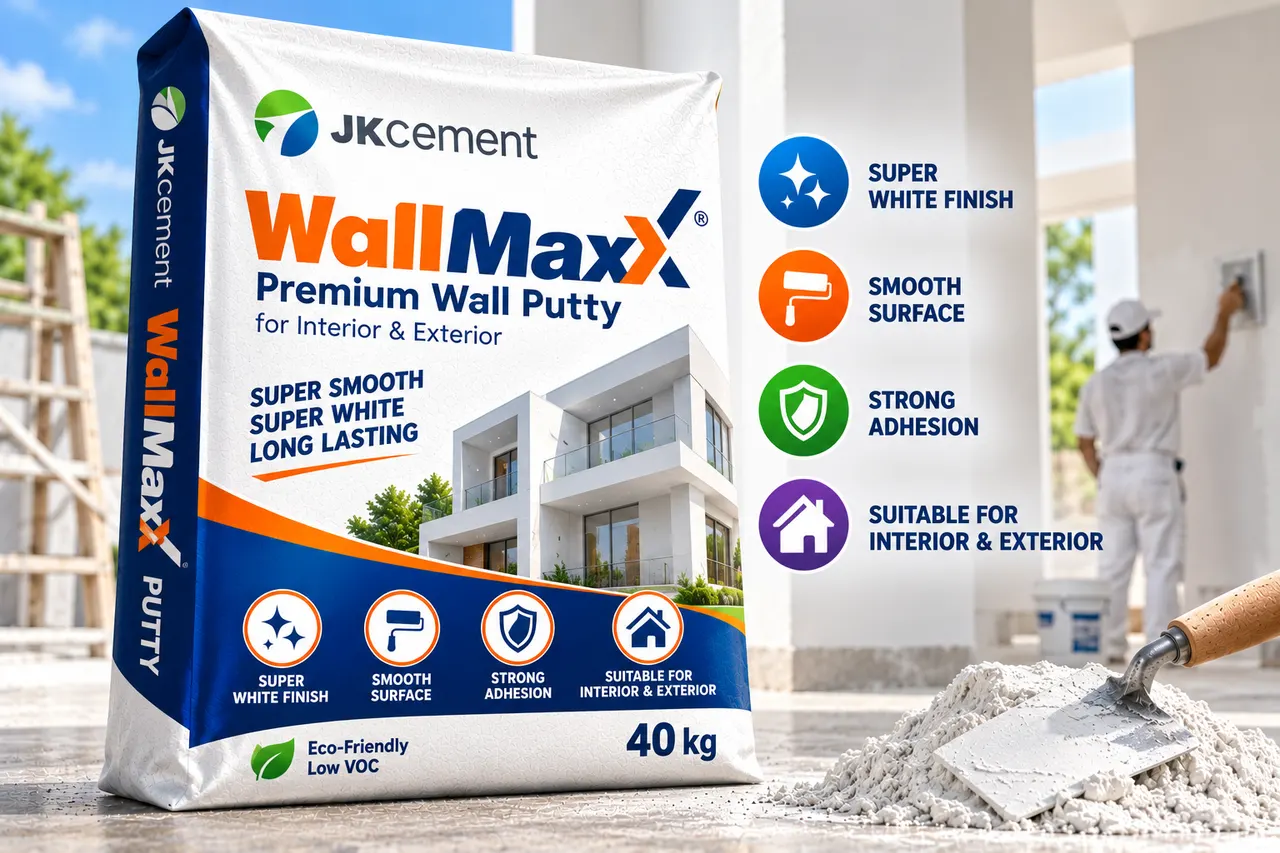
Wall putty is a fine, white-cement-based (or acrylic) filler applied over plaster to fill pores and minor undulations and give a smooth base for paint. Cement-based putty is water-resistant and suits interior and exterior walls; acrylic putty is for interiors. Apply two thin coats on cured, dry plaster (often around 28 days after plastering), sand lightly with emery paper between coats, then prime and paint. Check the manufacturer's coverage per kg on the bag for estimating.
What does wall putty do?
- Fills pores, hairline cracks and minor undulations in plaster
- Gives a smooth, uniform base for paint
- Reduces paint consumption by sealing the surface
- Improves paint adhesion and finish
It is not a substitute for proper plastering or crack repair. Structural or moving cracks must be addressed first — see cracks in concrete and plaster.
Types of putty
| Type | Base | Where | Notes |
|---|---|---|---|
| Cement-based putty | White cement, polymers, fillers | Interior and exterior | Water-resistant, strong bond |
| Acrylic putty | Acrylic emulsion | Interior only | Ready-to-use, easy sanding |
| POP (plaster of Paris) | Gypsum | Interior | Fast-setting, not water-resistant |
For damp-prone or exterior walls, use cement-based putty.
When to apply
Plaster must be properly cured and dry. A common guideline is to wait about 28 days after plastering (longer in humid weather) so moisture and alkalinity reduce before putty and paint.
Step-by-step application
- Clean the surface: remove dust, loose particles, oil and efflorescence.
- Repair cracks and holes with suitable filler.
- Dampen the surface lightly (for cement-based putty) — not soaking.
- Mix putty with clean water in the ratio printed on the bag; let it stand a few minutes and remix to a smooth paste.
- Apply the first coat thinly with a putty blade, bottom to top.
- Let it dry — typically several hours to overnight as per the manufacturer.
- Sand lightly with fine emery paper.
- Apply the second coat across the first for an even surface.
- Sand and dust off.
- Prime and paint with a compatible primer.
Estimating putty
Coverage depends on surface smoothness and coat thickness. Use the coverage figure on the manufacturer's bag for two coats, add 10% for wastage, and measure total wall area minus openings.
Common mistakes
- Applying on damp, fresh plaster — leads to flaking and patchy paint
- Thick single coats — cracks and long drying
- Skipping primer
- Using acrylic or POP putty on exterior or damp walls
Key takeaways
- Putty smooths plaster and saves paint; it does not fix structural cracks.
- Use cement-based putty for exterior and damp areas.
- Two thin coats on cured, dry plaster, sanded, then primer and paint.
Browse wall putty for your site.
Frequently asked questions
How many coats of wall putty are needed?
Two thin coats are standard, with light sanding between coats, followed by primer and paint.
How long after plastering can putty be applied?
Plaster should be cured and dry; a common guideline is around 28 days after plastering, longer in humid weather.
Which putty is best for exterior walls?
Cement-based (white cement) putty, because it is water-resistant. Acrylic and POP putties are for interiors.
Need materials for this work?
See indicative delivered prices for your pincode, or get an itemised project quotation with freight, unloading and GST shown line by line.
This guide is general information for planning and buying. Quantities, grades and methods for your structure must follow your approved drawings, your engineer’s specification and the applicable Indian Standards.