What Decides Cement Price in India? 9 Factors Every Buyer Should Know
The same bag can cost very different amounts in two towns. Here is what actually drives cement prices, and how project buyers can get a fair rate.
Cement prices in India depend mainly on production cost (fuel, power, raw materials), freight from plant to site, GST (18% on cement since 22 September 2025), regional demand and supply, season (prices often soften in the monsoon and firm up after it), brand and product, trade versus non-trade channel, order quantity and payment terms. For projects, compare the landed price — cement plus freight, unloading and GST — for your exact pincode.
1. Production cost
Making clinker is energy-intensive. Coal and petcoke prices, power tariffs and the cost of limestone, gypsum, fly ash and slag feed directly into the ex-plant price. When international fuel prices rise, cement prices usually follow with a lag.
2. Freight
Cement is heavy and relatively low-value, so freight is a large share of the delivered price. Distance from the plant or grinding unit, road vs rail, diesel prices and toll costs all matter. Sites far from plants pay noticeably more per bag.
3. GST
Cement (HSN 2523) attracts GST at 18%, reduced from 28% on 22 September 2025. Read GST on cement explained.
4. Regional demand and supply
Each region has its own balance of plant capacity and demand. A region with new capacity coming online may see competitive pricing; a region with heavy infrastructure activity may see firm prices.
5. Season
Demand usually slows in the monsoon and during major festivals and harvest periods when labour is scarce, and picks up after the monsoon and towards the end of the financial year. Prices often move with demand. See best time to buy cement.
6. Brand and product
Brands differ in price positioning. Within a brand, OPC 53 vs OPC 43 vs PPC vs PSC and premium variants are priced differently. See how to choose a cement brand.
7. Trade vs non-trade
- Trade cement is sold through dealers and retailers to individual buyers, with MRP printed on bags.
- Non-trade cement is supplied directly to projects, builders, RMC plants and institutions, often in bags marked "non-trade" or in bulk. Pricing is negotiated by project and volume.
The product standard is the same; the channel, packaging marking and commercial terms differ.
8. Quantity and delivery pattern
Full truckloads to one site cost less per bag to deliver than small, scattered drops. Committed monthly volumes give suppliers certainty, which usually earns better pricing. See bulk buying checklist.
9. Payment terms
Advance payment and short credit periods typically secure better rates than long credit. Credit cost is built into price.
How to get a fair price
- Compare landed prices, not ex-plant or "basic" rates. See how to read a quotation.
- Specify grade, brand options, quantity and delivery schedule in your enquiry.
- Ask for line-by-line pricing — cement, freight, unloading and GST separately.
- Lock a price for your full requirement with phased deliveries.
- Pay only through official channels — see safe payments.
Key takeaways
- Fuel, freight, GST, demand and season drive cement prices.
- Trade and non-trade channels are priced differently.
- Compare landed prices for your exact site pincode.
Frequently asked questions
Why is cement price different in different cities?
Mainly because of freight from the nearest plants, regional demand and supply balance, and local taxes and handling costs.
What is the GST rate on cement?
Cement (HSN 2523) attracts 18% GST from 22 September 2025, reduced from the earlier 28%.
What is non-trade cement?
Non-trade cement is supplied directly to projects, builders and institutions rather than through retail dealers. It meets the same standards but is priced and marked for the project channel.
When are cement prices lowest?
Prices often soften during the monsoon when construction demand slows, but this varies by region and year.
Need materials for this work?
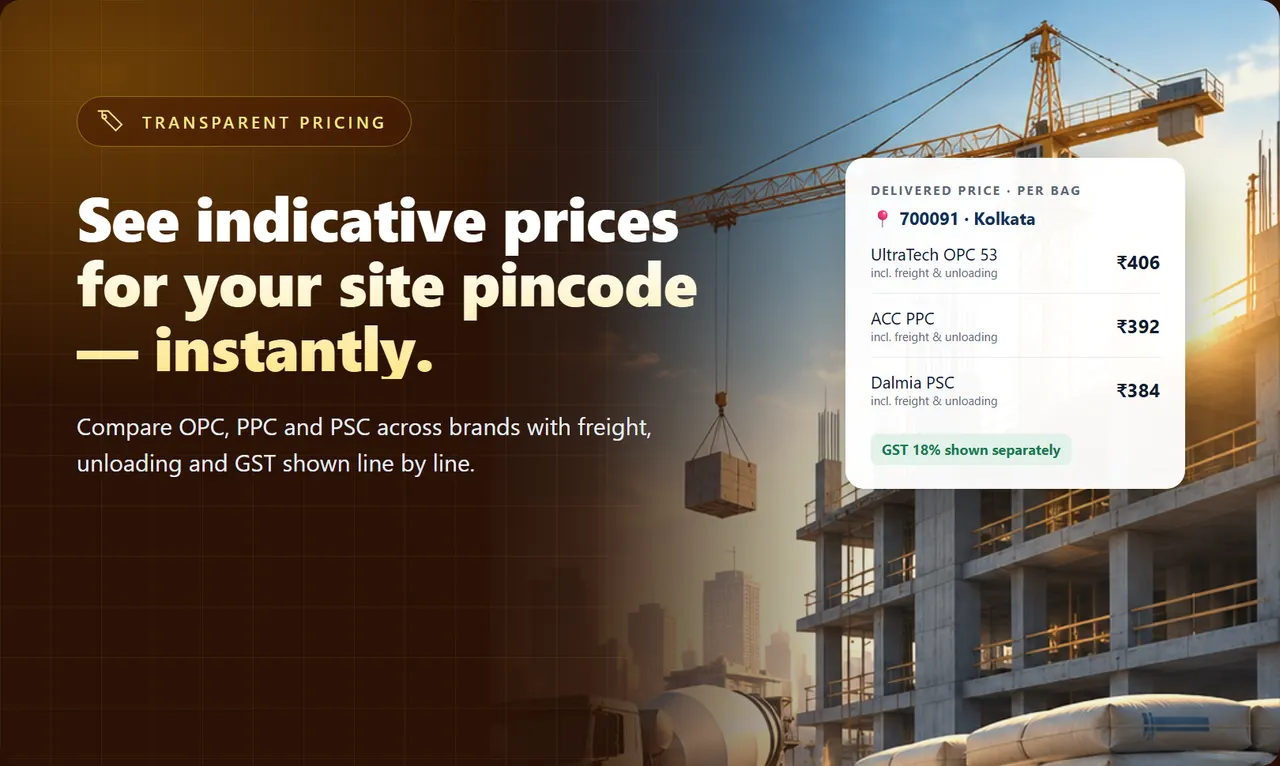
See indicative delivered prices for your pincode, or get an itemised project quotation with freight, unloading and GST shown line by line.
This guide is general information for planning and buying. Quantities, grades and methods for your structure must follow your approved drawings, your engineer’s specification and the applicable Indian Standards.